A DIRECT ACCESS
TO SPIRITUAL DEVELOPMENT
For truly seekers of liberation.
You think you're awake - NO, you're asleep and dreaming*.
If you are embedded in specific tradition of teachings (buddhism or yoga), then regard this text as a mind-opener or as a expander of your present spiritual knowledge and do not reject it at first sight - act as an exploring archaeologist: dig first and evaluate or apply later.
Don't be confused by the many books, writings, videos, lectures of the many lamas or yoga teachers who are quite active in these times. They all present a fragment or personal interpretation of scripts, what they have studied and what belong to their tradtion and being written down long time ago by others. If they stick to the scripts, then they might lack of personal experience. Certainly nobody asks to what level your lama has practiced (see Jhanas). The quantity of (fractured) information is certainly no guarantee for effective teachings from zero to spiritual perfection and to Nirvana.
Let us be honest: Virtually no one has found so far a true bodhisattva as a master, because they are very rare, and good students are even rarer. So keep in mind: That what is taught to you certainly lacks of own profound spiritual experience of the presenter and can be limited and faulty, so it is up to your karma in what you devote yourself (expectations are always influenced by the own personality) when pursuing the spiritual journey. Checking and looking around is not forbidden, just like critical questions - the common sense may not be weakened. A true master allows during his lectures questions - if not, then be sceptical. He also tells nice episodes of his life with his master, which are amusing and inspirative, but also from those who did not make it.
300 million humans are practicing meditation and embark on a path that is truly unproductive. Why? Because they enjoy a path which does not conquer or touch the ego but gives good leisure time by practicing guided meditation or attending ceremonies. They float along on these practices, but attaining a higher level of alertness requires more than a standardized effort. Those who jump first into meditation assuming the Noble Morality comes on second or third place, are not honest seekers. And do not become a "mechanical buddhist".
Ceremonies etc. create ideas and mental impressions that are not permeated by a HIGHER STATE OF WAKEFULNESS and therefore tend to lead astray and they convey the illusion of having accomplished something – no, it's merely a horizontal effort. Those who like to stick to ceremonies, thangkas, buddha statues (colorful and in gold) still are slaves to their senses (refer to "daily consciousness driven by the skandhas") - this kind of consciousness lacks of power of discrimination! Everybody can meditate or lead a guided meditation with softly spoken texts what point to a certain direction surely the disciple does not need now. Only a true spiritual master can do this and he does this individually – for everyone differently.
There are 3 types of life processes which create karma: Thinking, Feelings/Emotions and Acting. THINKING creates almost all of your karma. DO NOT RELY PRIMARLY ON ceremonies, prayers etc. WATCH your thinking all the time (24/7) thru mindfulness and maintain "mental hygiene" for the good and for higher goals.
The bitter truth is that many people like illusions and promises, they like to stay comfortable and cosy in a crowd of a sangha – it is much easier: the ego stays untouched. They are still dreamers. Be aware: the "most-precious ego" is very smart and uses your own potential to keep you off from progress and furnishes you with wrong realities - it does not want to lose power like the dictators in the real world. If you are longtime follower of guided meditation it migth happen that now an aversion rises within you, don't give in. The fully-awakened-ones divide humanity into sleeping, dreaming and awakened. Staying in a retreat only makes sense when there a true spiritual master is present and guides you personally to reach the next higher step (there are about 200) and can invoke the next level for you - otherwise it is a social gathering like in a club - you go home and are still the same in your inner structure. Remember: in death only that counts what you have achieved in transforming the subconscious since this is your imperishable possession - all knowledge of the scripts flies away in this moment. If you practiced self-observation and concentration, then, well then you are well equipped in the bardo. The transforming happens by purifying (cleaning) the subconscious, where many bad and dark "power packages" (mines) are stored and dictate your opinions and sights, reflexive reactions, impulses, your emotions and the content of your endless thinking - in short they determine your daily life and hence your karma, and must be dissolved or transformed into sattvic energy, this "job" has the highest priority and takes the longest time and needs perserverance. Being successful in this you surely experience soon some kind of awakening and a joyful "Inner Self". The right way to practice this is explained in the book. The first main level is to realize that maintaining inner factors like joy or bliss are more important than extern factors (like enjoyment).
But illusions or imaginations must be eliminated otherwise the sharpness of higher wakefulness and the inner point of creating emptiness never appears, both are mandatory for progress and to avoid traps. And compliance to the basic rules like the Noble Morality and Bodhicitta must be followed in daily life – no sangha, no retreat and no teacher is needed for this endeavour. Keep in mind: to be in a sangha is nice and inspirative, but no one there will help you on your spiritual path – all must be done by yourself with your own inner abilities and will. Maro (the eternal tempter) and his many helpers never sleep, they build traps in sanghas too.
If you really are a true seeker (see checklist) and want to escape the invisible bondage of the materialistic world and its demonic influence forever so read the teachings and recommendations given in this book, which is really unique – you will find 5 applicable key instructions of 3 buddhas of 3 eras. Start purifying yourself. Remember: Many authors only progapate their own „product“ resp. their own eastern traditional sight which is not best suitable for people in the west in the 21st century. And there is some "competition" by adopting teachings to rally "donators" and sect syndrome causing stagnation or dumbing down looms, if you are still spiritually dreaming. If you are spiritually alert and courageous, then ask your lama what spiritual level he has reached - a genuine spiritual master has no problems with it. He will convince you in one way or other. The teachings must create some progress in due time to convince you about the path (see link to checklist). Later when having realized spiritual perfection (and wisdom), you can work yourself infallible for the benefit of others (Mahayana), but to achieve your own spiritual perfection must be your priority now ...
Give it a try – open your mind to the boundless emptiness and wisdom. All what you need is here in this book. Read the "introduction chapter" of the book down below.
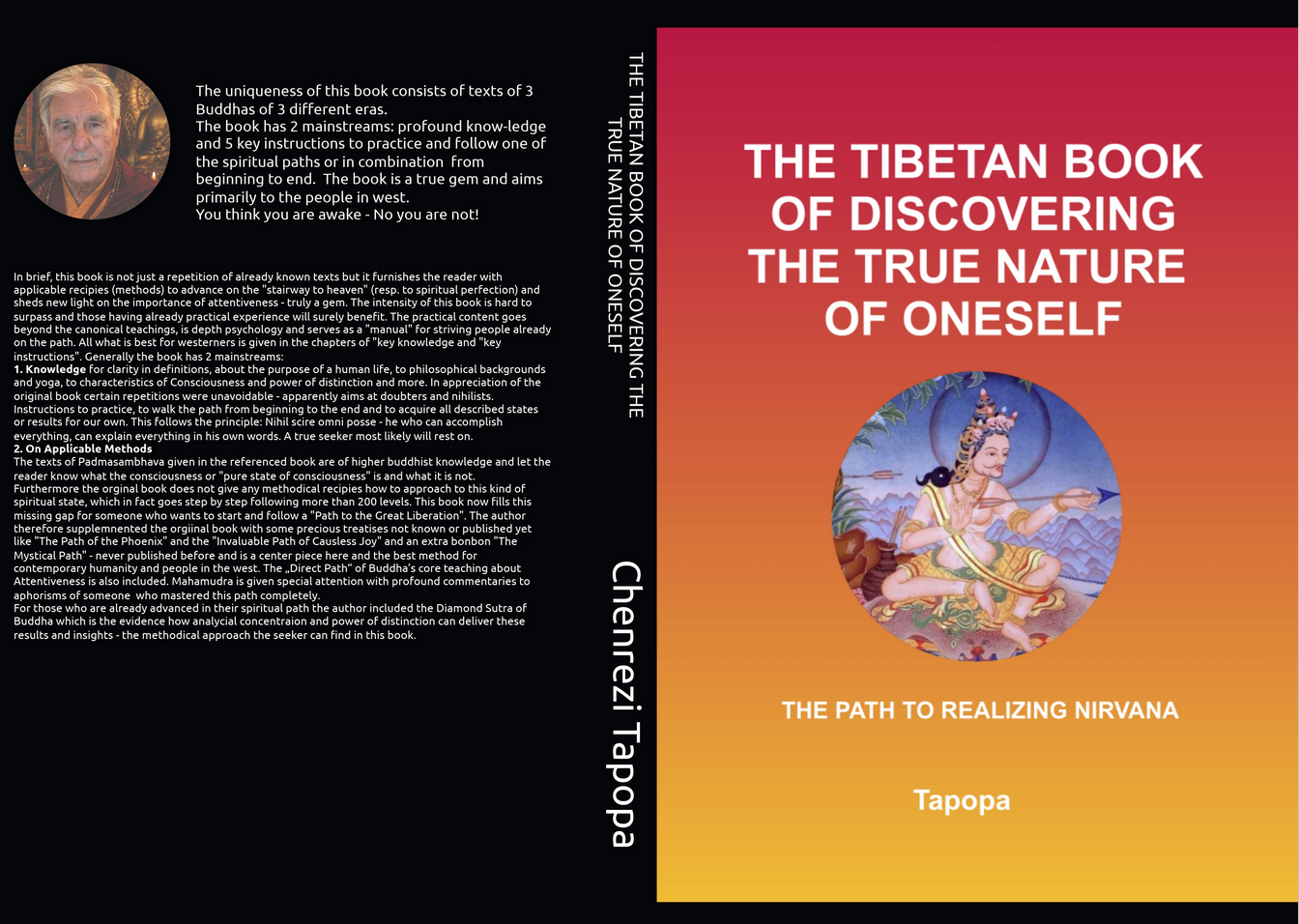
THE TIBETAN BOOK OF DISCOVERING THE TRUE NATURE OF ONE-SELF
Download the PDF here english or spanish (200+ pages) for free ... also available as paperback.
NOTE: A good sangha is that sangha, where spiritual topics (100+) about life, human being and subtle components, their inner mechanics, about karma, about the cosmos and the spiritual steps and methods are lectured combinded with the practice of the concentration to transform the subconcious into pure light and merge it with the supreme consciousness - this is what any path is all about.
* Once you were able to activate the Buddha Eye for the first 1-2%, thru some practice or by the grace of your Guru, you will know what that means. And you will recognize that it is very difficult to convince others that they are still asleep in the spiritual sense.
CHAPTER INTRODUCTION OF THE BOOK ...
UNIQUENESS
The uniqueness of this book is the merging of texts and profound knowlege of spirital masters (buddhas) of the 5th BCE and 8th AC and of the 20th AC century. In brief, this book is not just a repetition of al-ready known texts but it furnishes the reader with applicable recipies (methods) to advance on the "stairway to heaven" (resp. to spiritual perfection) and sheds new light on the importance of attentiveness - truly a gem. The intensity of this book is hard to surpass and those having already practical experience will surely benefit. The practical content sidestep the canonical teachings and aim directly to the supreme goal, is depth psychology and it serves as a "manual" for striving people already on the path. All what is best for westerners is given in the chapters of "key knowledge, "key instructions" and Buddhas core teaching. Generally the book has 2 mainstreams:
1. Knowledge for clarity in definitions, to purpose of a human life, to philosophical backgrounds and yoga, to characteristics of Conscious-ness and power of distinction and more. In appreciation of the original book certain repetitions were unavoidable - apparently aims at doubters and nihilists.
2. Instructions to practice, to walk the path from beginning to the end and to acquire all described states or results for our own. This follows the principle: Nihil scire omni posse - he who can accomplish everything, can explain everything in his own words and does not need scripts written down by others some time ago. A true seeker most likely will rest on these parts of the book.
This book does not substitute basic spiritual and canonical literature (see chapter „Literature“) on Yoga and Buddhism; it is an "essence" of all those – a true juwel for the seekers for liberation. If a reader knows the original book "The Tibetan Book of the Great Liberation" he will notice, that a large part deals with life and work of Padmasambhava, which is unique and does not help you on your own spiritual journey; it is just inspirative. That's why this is omitted and the content here is focu-sed on you and your destiny.
Text passages highlighted in bold serve to draw attention to specific topics within a chapter, as readers tend to browse or simply skim thru them - lol.
ON CONSCIOUSNESS
The texts in the treatise "The Tibetan Book of The Great Liberation" of Padmasambhava use the word "Mind" or "One Mind" as the ultimate component in human, what can be developped to realize the ultimate truth and therefore lead to Nirvana - but it is not the Mind, it is the Conciousness. This misinterpretation of the term "mind" versus the term "consciousness" by the former translator W.Y. Evans-Wentz is presum-ably due the psychological knowledge of 1927. Only the transcendental component Consciousness has the capability to lead to spiritual perfection and to Nirvana. Hence the author included a list of definitions for psychic components and psychic states and psychic or spiritual results when practicing the Dharma. A common understanding and use of certain terms is highly recommended, since dogmatists and scholars love to argue and twist its meaning. A more detailed and unique ex-planation is given on the functionaltiy of the consciousness, of the mind and other components which are subject to the inevitable transformation process - see chapter "Indispensable Knowledge" and "What are Jhanas?".
ON APPLICABLE METHODS
The texts of Padmasambhava given in the referenced book are of higher buddhist knowledge and let the reader know what the consciousness or "pure state of consciousness" is and what it is not.
Furthermore the orginal book does not give any methodical recipies how to approach to this kind of spiritual state, which in fact goes step by step following more than 200 levels. This book now fills this missing gap for someone who wants to start and follow a "Path to the Great Liberation". The author therefore supplemnented the orgiinal book with some precious treatises not knownor published yet like
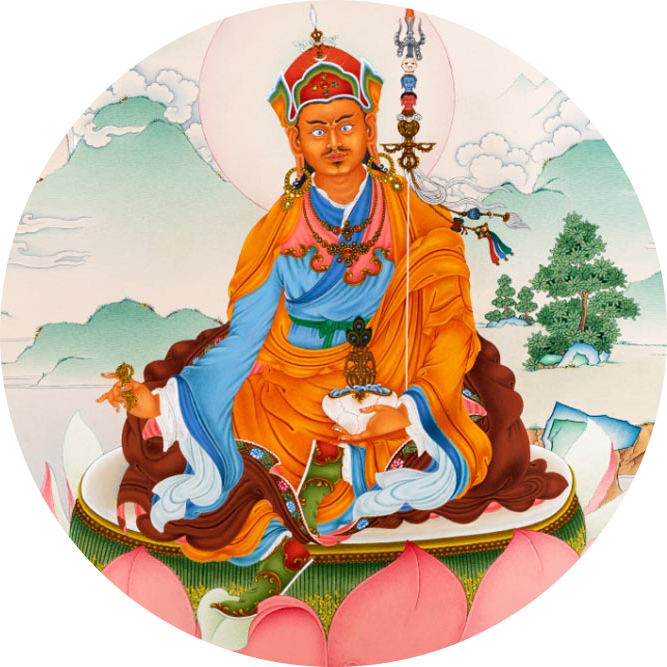
"The Path of the Phoenix" and the
"Invaluable Path of Causless Joy" as an extra bonbon
"The Mystical Path" - never published before and is a center piece here. The embedded
"Introduction to the Mystical Path" and "Introduction to the Intellectual Yoga" are treatises never seen or heard before: its significances are of utmost importance for any spiritual development, for science and religions likewise.
"Mahamudra" as philosophical part to the "Path of the Phoenix", which is the applicable part
For those who wish to extend their practice and are already progressed on their spiritual path the author included Buddha’s Direct Path (of Attentiveness), the Prajna-Paramita and the Diamond Sutra of Buddha which is the evidence how analycial concentration and power of distinction can procure these results and insights - the methodical approaches the reader can find in this book. The true Raja Yoga of Patanjali and revived by Vivekananda is not in this book - Raja Yoga demands a true Guru after the stage „Asana“ – no Pranayama without one. By the way: A true spiritual master knows all paths of this book.
ABOUT TANTRA
The Tibetan Tantra practices consists of accumulations of various visible and audible practices (praying, singing-reciting, drumming, medi-tating, integrating ideas) and they need a sangha in „exoctic or colorful“ environment. Every tradition has its own systematics. It is said, this is the fastest path for spiritual perfection (enlightment), which is not true – the fastest path is Mahamudra, whose practice is explained in „The Path of the Phoenix“, where higher awakness manifests soon. True Tantra practice needs the ability of „one-pointedness-concentration“ and this is only for advanced disciples where their practices are controlled by a true master. So nothing for those on the lamrim-ngöndro preparation path. Real Tantra Practices aim to the realization of mystical powers and more higher qualities by using the potential of the Mind (see chapter „Tantra and the Mind“) and the reunion of space (akasha) and prana (energy) into ONE. The breakthrough to the light of the Dharmakaya is achieved differently. That is why the specific methods are not explained here. The true origin of Trantra is India. Tantra practices are pure esoteric (identifications) and not exoteric (tsoks etc.). Trantra is considered as part of the Vajrayana. The main goal of the trantric practices are transformative. But this takes place on other paths as well, for instance the core of Theravada, Satipatthana, is also considered as transformative and burning – so no reason to regard it as inferior. The combination of both is highly recommended. Furthermore there is no historical evidence that Buddha Guatamo has taught Trantra, especially not in the way the Tibetan propagate it nowadays - Tantra is branded for many sorts of „exclusive“ practices. The Tibetans have mixed the Tantra with Lamrim and hereby created a „new system“. The black Tantra is for (bad) magic powers, the red Tantra attracts animalistic people still inter-ested in sensual pleasures, whereas the white Tantra is the right one. The use of black Tantra was the cause why Tibet has lost its Buddha and its protection against outsiders.
But the reader may be assured, that the securest path is the Mystical Path (for complete indestructibility) where later "you can walk with your slippers into heaven" or enter the „realm of Vairocana“ anytime at will. That is why this path is explained in detail in this book. The Mystical Path achieves same results as Vajrayana with Tantra but without any perils to become a demon. A contemporary Buddha, knowing profoundly the humans by their karma and their present mindset (done by many direct identifications and being in them), teaches this path first. After having accomplished the ultimate realization all other systems and methods will be explored, combined with the ability the use them wisely.
TO BE NOTED
Even if the texts read themselves quite easily and generate enthusiasm but omitting the importance of the Noble Precepts of Morality and not considering them in daily life can lead to a backlash or stagnation. Just meditating only without gaining insights about oneself remains a nice hobby. About 300 million people meditate more or less regularly on this planet. If just one out of a million would do it in the "right way", the world would have 300 bodhisattvas or perfect yogis and less dictators. The Noble Precepts are given to guarantee success on any path and to avoid traps, they include much more subtleties than just a compliance with civil laws. Someone who travels often to attend new events and if it is not the same spiritual master who has accepted him as disciple, this one is not searching for the "standstill and unchanging" within; this one is still looking for diversification and prefers social embeddedness.
Because of the special significance of consciousness, it was treated in writing like this: Consciousness.
BUDDHA? (for newcomers)
The term "Buddha" can have two meanings: firstly, it refers to the historical Buddha Gautamo (Shakyamuni) and secondly to anyone who has attained and stabilized the cosmic state of infallible consciousness and wisdom, regardless of the system of spiritual development they followed. Jesus Christ also achieved this: "Christos" is another name for the Buddha-state. In other words, a Buddha is the centralized union of humanity's most valuable attributes in a single person. There were many Buddhas before the historical Buddha, and also after him, and even today (they are active in secret). The antagonist of spiritual light is Maro, also known as Satan - but his power is limited (or mastered) by the transcendental or cosmic light. He has numerous helpers (little Maros), which like to fight each other too.
In Yoga, a Buddha or an Enlightened One is called a "Jivanmukta" and his state of consciousness is called "Turiya". An enlightened being who explains a path of spiritual development to people and successfully guides them along is a Bodhisattva, a Spiritual Master, or a True Guru. And there is always "Guardian of the Teachings" on earth.
Generally, once consciousness has grasped emptiness, all distinctions disappear; only absolutely objective reality and its understanding remain. All differences in educational systems become irrelevant. Anyone who crosses the threshold into emptiness must master Pranayama and Dhyana.
Have a good read and a good practice.
Tapopa 2026
Erstelle deine eigene Website mit Webador